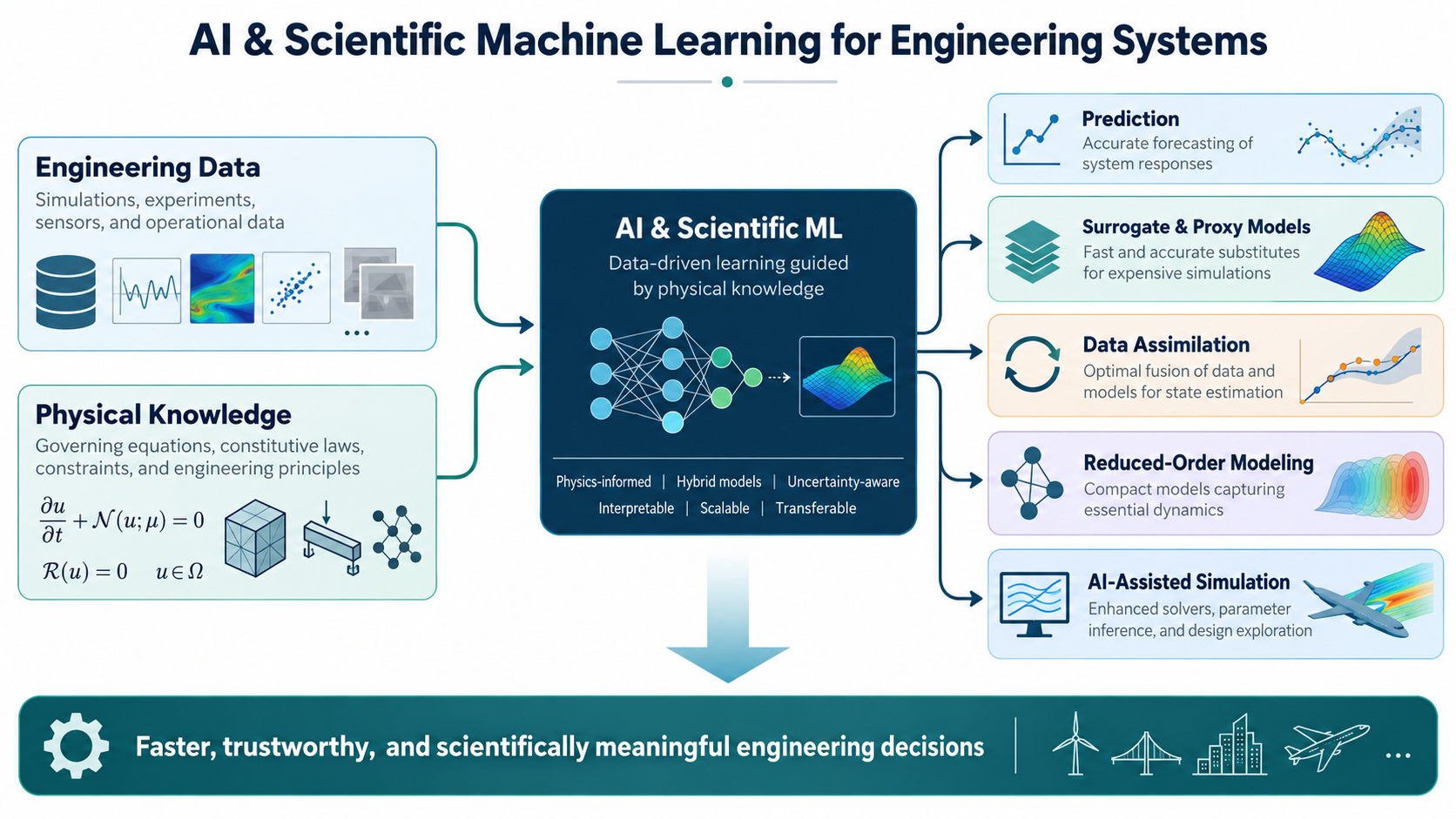
1. AI & Scientific Machine Learning for Engineering Systems
We develop artificial intelligence and scientific machine learning approaches to improve the modeling, prediction, and understanding of complex engineering systems. Our research integrates data-driven methods with physical knowledge, numerical simulation, and domain expertise to develop models that are both computationally efficient and scientifically meaningful. Key areas include deep learning, surrogate and proxy modeling, large language models, data assimilation, reduced-order modeling, and AI-assisted simulation. These methods are applied to problems where conventional physics-based models may be computationally expensive, data may be sparse or uncertain, or rapid prediction is needed to support real-time engineering decisions. Our broader goal is to develop trustworthy and practical AI methods that complement traditional engineering analysis rather than simply replace it.
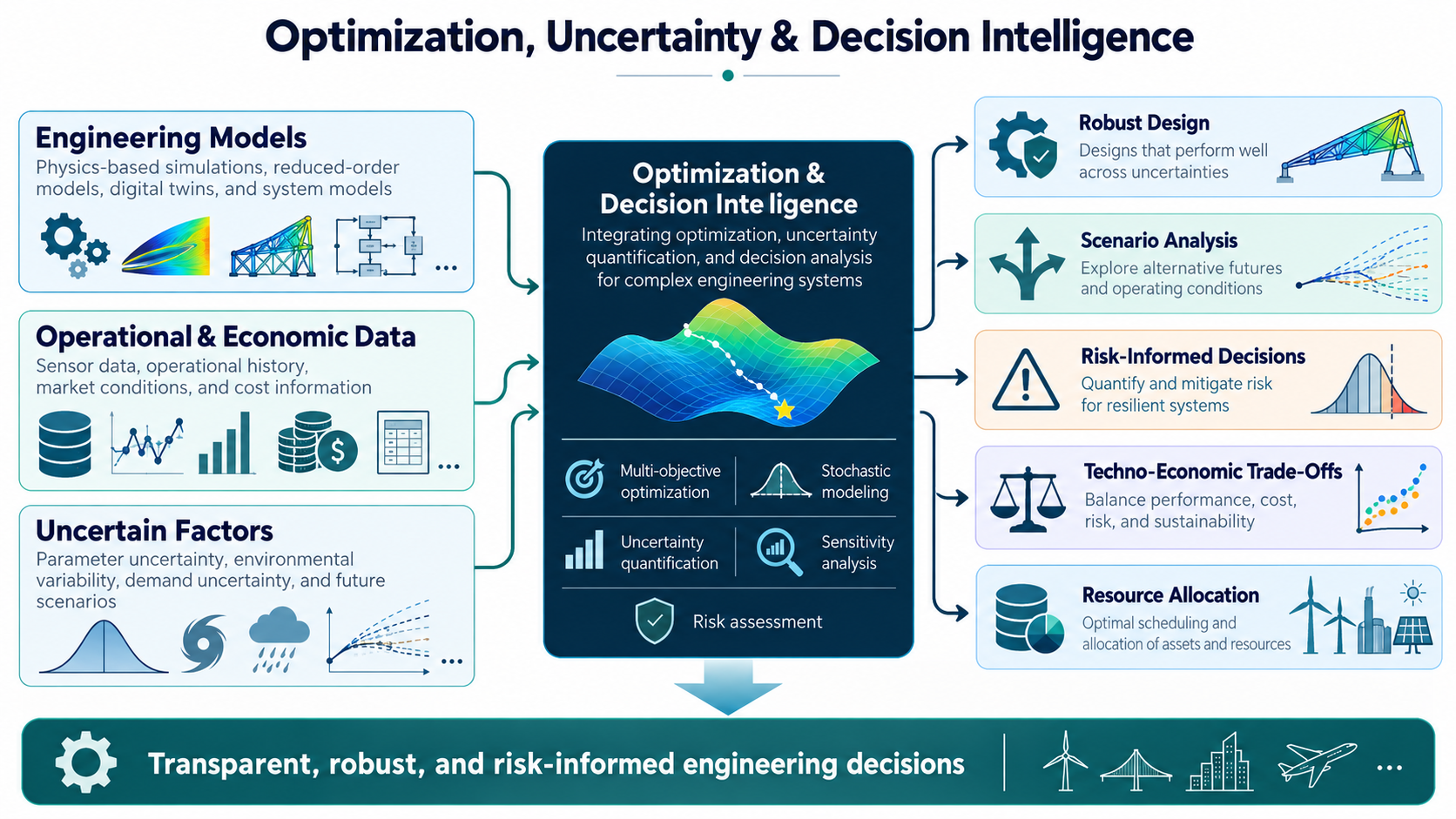
2. Optimization, Uncertainty & Decision Intelligence
We develop computational frameworks for making better engineering decisions in systems characterized by uncertainty, competing objectives, and complex trade-offs. Our research combines mathematical optimization, multi-objective decision-making, uncertainty quantification, stochastic modeling, sensitivity analysis, risk assessment, and techno-economic analysis. Particular emphasis is placed on understanding how uncertain technical, economic, environmental, and operational factors influence system performance and investment decisions. By integrating simulation, optimization, and data-driven methods, we aim to identify solutions that are not only technically feasible and economically attractive, but also robust under uncertain future conditions. These approaches support transparent and risk-informed decision-making across energy, infrastructure, environmental, and industrial systems.
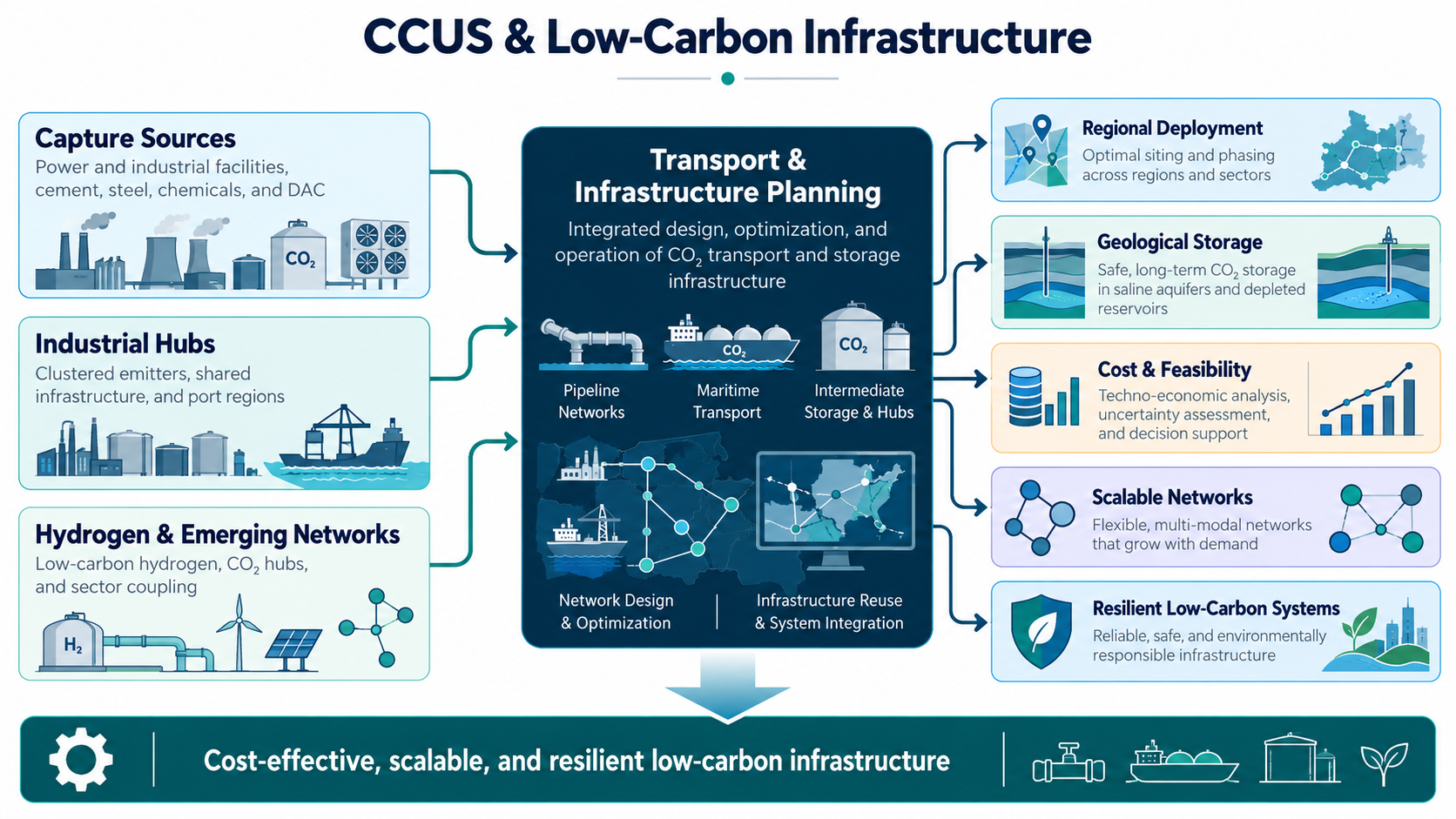
3. CCUS & Low-Carbon Infrastructure
We develop models, optimization frameworks, and decision-support tools for the planning and deployment of carbon capture, utilization, and storage and other low-carbon infrastructure systems. Our research covers the full infrastructure chain, including CO₂ capture sources, pipeline and maritime transport, intermediate storage, geological storage, infrastructure reuse, and integrated network design. We investigate how infrastructure configuration, scale, geography, cost, uncertainty, and operational constraints influence the feasibility of large-scale decarbonization systems. Beyond CO₂ infrastructure, our work also extends to hydrogen transport and other emerging low-carbon energy networks. A major objective of this theme is to connect detailed engineering analysis with regional and system-level planning so that low-carbon infrastructure can be deployed in a cost-effective, scalable, resilient, and risk-aware manner.
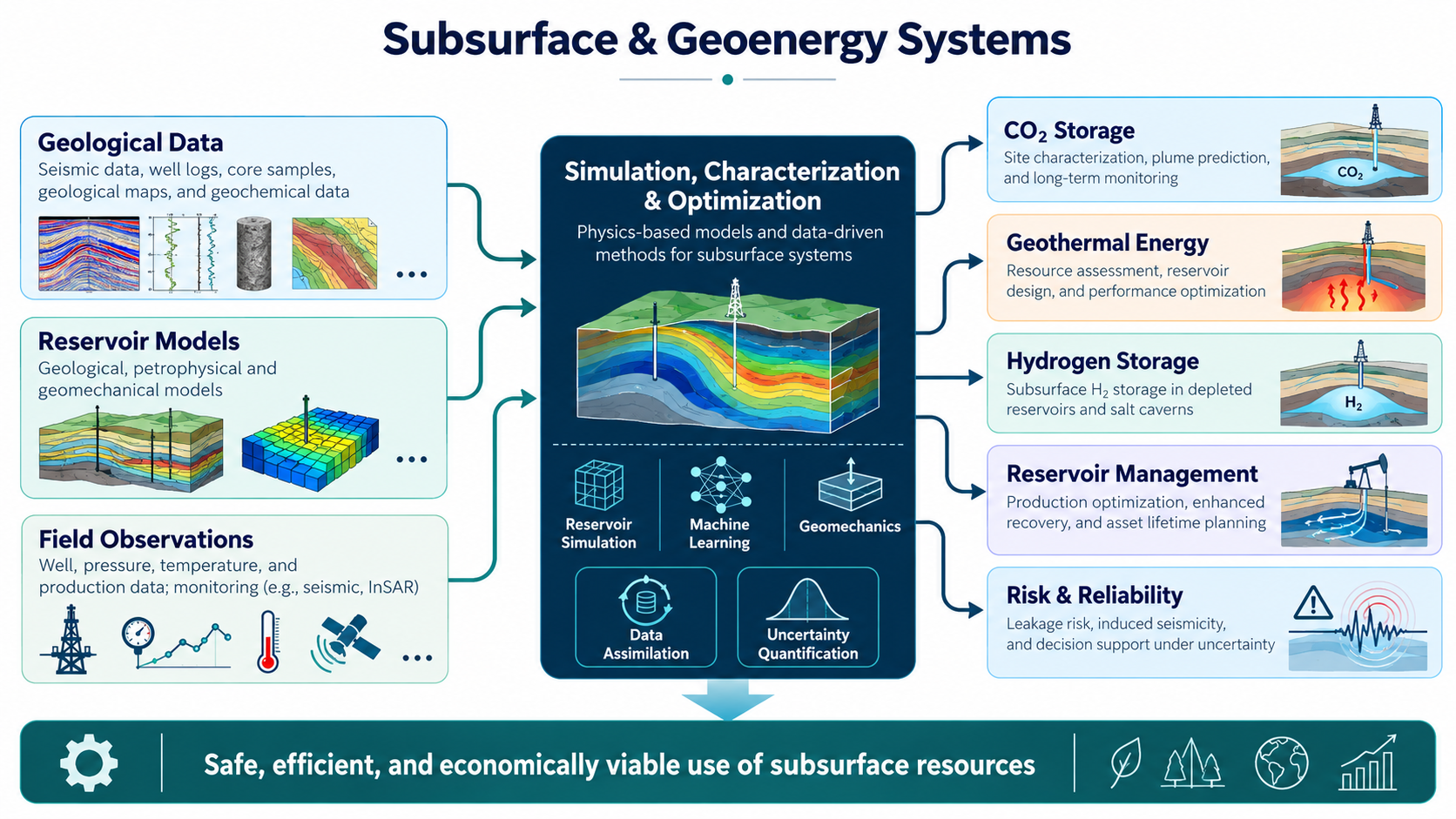
4. Subsurface & Geoenergy Systems
We develop computational methods for the characterization, simulation, optimization, and management of subsurface energy and storage systems. Our research addresses applications including geological CO₂ storage, geothermal energy, underground hydrogen storage, reservoir management, fractured porous media, and subsurface risk assessment. We combine reservoir simulation, machine learning, optimization, geomechanics, data assimilation, and uncertainty quantification to better understand subsurface behavior and improve operational decisions. Particular attention is given to geological heterogeneity, limited observations, model uncertainty, storage performance, injectivity, leakage risk, and long-term system reliability. Through this work, we aim to improve the safe, efficient, and economically viable use of subsurface resources as a critical component of the global energy transition.